 Brown&Co

Fuelling the crisis: rising diesel prices and their squeeze on UK agriculture
Fri 05 Jun 2026
UK agriculture is experiencing one of its most challenging cost of production environments in recent years.
The ‘perfect storm’ of geopolitical instability, volatile markets and falling farmgate returns are putting farmers, growers, and agricultural contractors under intense pressure. Fuel, an input of necessity on every farm, sits at the centre of that storm, its price once again a defining issue for the sector.
Data pulled from Brown&Co’s latest Agriculture Update illustrate some of the factors responsible for that financial pressure:
- Red diesel increased by 50.52pence/litre across the quarter January 2026-March 2026 hitting 117.08pence/litre, an increase of 76%
- Crude oil prices rose by $30.62/barrel across that quarter, peaking at $87.07/barrel, an increase of 54.25%.
As this data shows, fuel prices dramatically escalated during this quarter, driven by the instability in the Middle East, particularly the conflict involving Iran.
This price spike is already feeding through to fertiliser prices which, on top of cycles of bad weather and reduced income, is creating a tough environment for farm businesses.
The oil shock is the second major one in just four years, the first resulting from Russia's invasion of Ukraine in 2022.
For agricultural contractors and operators in contract farming agreements (CFAs), the exposure is particularly acute.
In a CFA, the contractor provides all the labour, machinery, and fuel, and the other party the land and buildings. Fuel cost increases must either be absorbed or renegotiated and that can lag months behind the market.
As we move forward, fuel price escalators are becoming more prevalent within the CFAs we oversee at Brown&Co.
Escalators are designed to fairly reflect the changes in fuel prices in the payments made to the contractor each farming year.
For example, if a fixed Fuel Reference Price of 65 pence/litre is used as a baseline, when the contract was agreed, this is then compared against the contractor’s actual average fuel cost for tractor gas oil during the whole year.
The difference between the two figures, known as the Fuel Price Change, will show whether fuel has become more or less expensive. Any change is then multiplied by a standard Fuel Usage Rate of, for example 100 litres per hectare, to calculate a Fuel Adjustment value in £ per hectare.
Finally, this per hectare adjustment is multiplied by the total cropped area to determine the Fuel Cost Adjuster, which is either added to, or deducted from, the contractor’s charge. If fuel prices rise above the reference price, the contractor receives an additional payment to cover higher costs; if prices fall below the reference, the payment is reduced accordingly.
- The example below illustrates what this looks like in practice:
- Actual price of fuel, as referred to within the CFA - 65ppl
- Fuel price change: average price of fuel 117ppl minus Fuel Reference Price of 65ppl - 52 ppl
- Fuel Adjustment: fuel price change of 52 ppl x Fuel Usage Rate of 100 litres/ha - £52.00
- Fuel Cost Adjuster: fuel adjustment of £52.00 x 300ha (assumed cropped area) - £15,600 in addition
The contractor's charge within a CFA agreement was never designed to absorb price shocks at the scale now being experienced, it was built around stable input assumptions, with fuel costed in at normal trading levels, not the extremes being seen today. Naturally, fuel consumption per hectare can vary and be agreed between parties.
Harvest to crop establishment is the most fuel intensive period of the farming year, involving combining, grain carting, heavy cultivations and drilling operations. Without a fuel escalator clause in the agreement, there could potentially be no mechanism to cover that expensive difference in fuel, leaving the contractor out of pocket.
To review existing agreements or machinery costings please contact your local Brown&Co office.
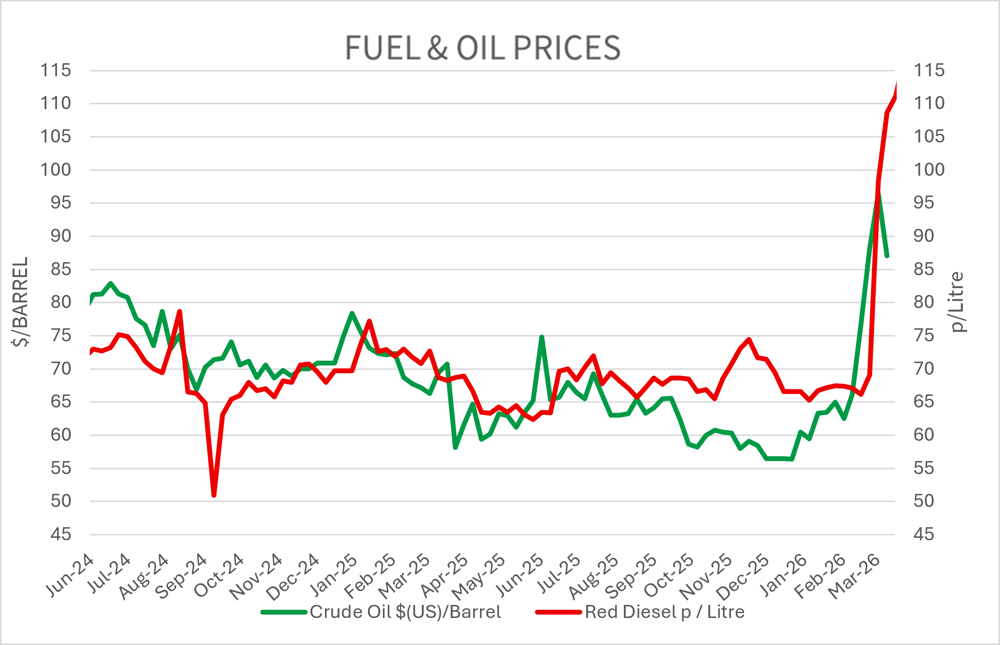
Sources: AHDB Fuel Prices tracker, Brown&Co quarterly update, Farmers Guardian
Keep updated
Keep up-to-date with our latest news and updates. Sign up below and we'll add you to our mailing list.